Pneumoconiosis - Silicosis
Pneumoconiosis are part of restrictive chronic interstitial lung diseases and have mainly professional character. Depending on the inhaled air pollutants, pneumoconiosis are divided into : Coal workers pneumoconiosis / anthracosis, Silicosis, Asbestosis, and Berylliosis.
The severity of the lesions depends on the length of exposure, type, concentration, size and shape of the inhaled particles, additional factors (smoking), or immunological status of the patient.
Silicosis has as etiologic factor prolonged exposure to silica dust (sized between 3-5 microns), which causes progressive fibrosis.
It is an occupational lung disease affecting workers in construction, mining, non-metallic mineral products, pottery and glass industry.
Once inhaled into the alveolar spaces, silica dust interacts with alveolar macrophages. Activated alveolar macrophages seems to secrete a fibroblast grown factor which stimulates the fibroblasts to produce collagen around the silica particles. Continuous accumulation of collagen produces silica nodules, peribronchial and perivascular fibrosis.
In the early stages, macroscopically, one can identify small pale or dark (in association with anthracosis) nodules, located predominantly in the upper lobes (Figure 1). In later stages of the disease, the fibrous nodules enlarge and merge, resulting in large areas of fibrosis.
Nodules can present central ischemic necrosis. People with silicosis are at high risk for developing tuberculosis (silico-tuberculosis).
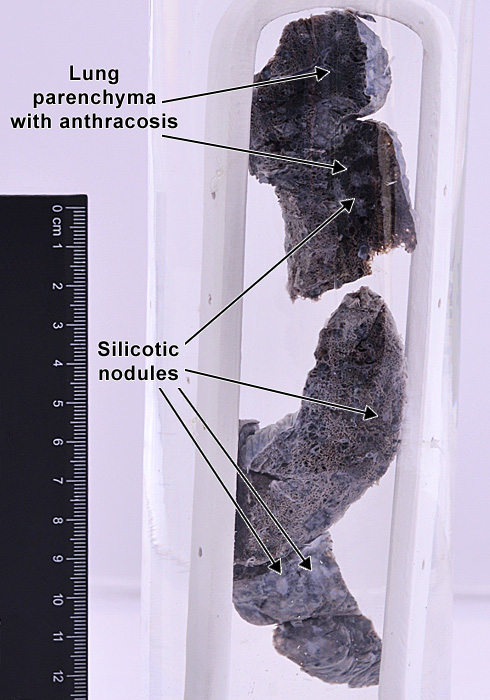
Figure 1 : Silicosis
Microscopically, silica nodules consist of concentric laminated collagen fibers (blue, in Simionescu trichromic staining) and tend to become confluent, compressing adjacent alveoli. Silica crystals appear as empty cleft-like spaces (Figure 2). With progression, perivascular and peribronchiolar collagen deposits will produce pulmonary hypertension.
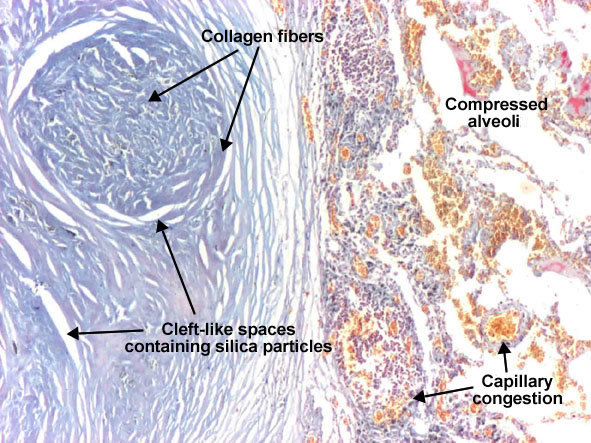
Figure 2 : Pulmonary silicosis (Simionescu trichromic staining, ob. x4)

 s-soft